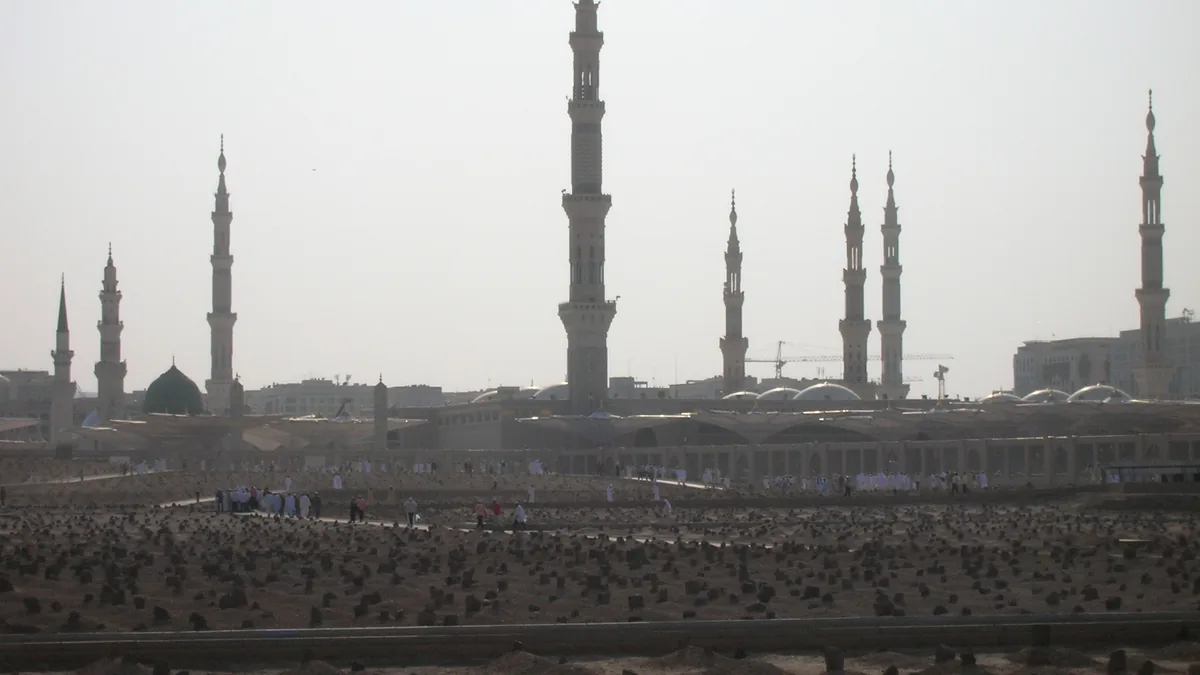
Jannat ul Baqi is the main cemetery of Madinah, just south-east of Masjid an-Nabawi. Many members of the Prophet Muhammad’s ﷺ family and thousands of his Companions are buried there. For most pilgrims, a quiet visit to greet them and pray for them is one of the most moving moments in Madinah.
This guide gives a short, neutral history of the cemetery and explains who is buried there. It then covers the practical side: where it is, when it usually opens, the rules for women and the greeting the Prophet ﷺ taught for visiting the graves.
Quick answer
- Al-Baqi is Madinah’s oldest Muslim cemetery, a short walk from Masjid an-Nabawi.
- The Prophet’s wives, his son Ibrahim and many Companions are reported to be buried there.
- Men can usually enter for a while after Fajr and after Asr. Times change, so check on the day.
- Women usually make dua from outside the wall. Say the Sunnah greeting from Sahih Muslim 974a.
What is Jannat ul Baqi?
It is Madinah’s oldest Muslim cemetery, known in the early sources as Baqi al-Gharqad. “Jannat” means garden, so Jannat al-Baqi is a loving popular name for it. The Prophet ﷺ buried members of his family and Companions here, and he often visited it to pray for them.
The hadith use the name Baqi al-Gharqad. In one report, Aisha describes the Prophet ﷺ going out at night to al-Baqi and asking Allah to “grant forgiveness to the inhabitants of Baqi’ al-Gharqad” (Sahih Muslim 974a). Gharqad is the name of a thorny shrub that once grew here.
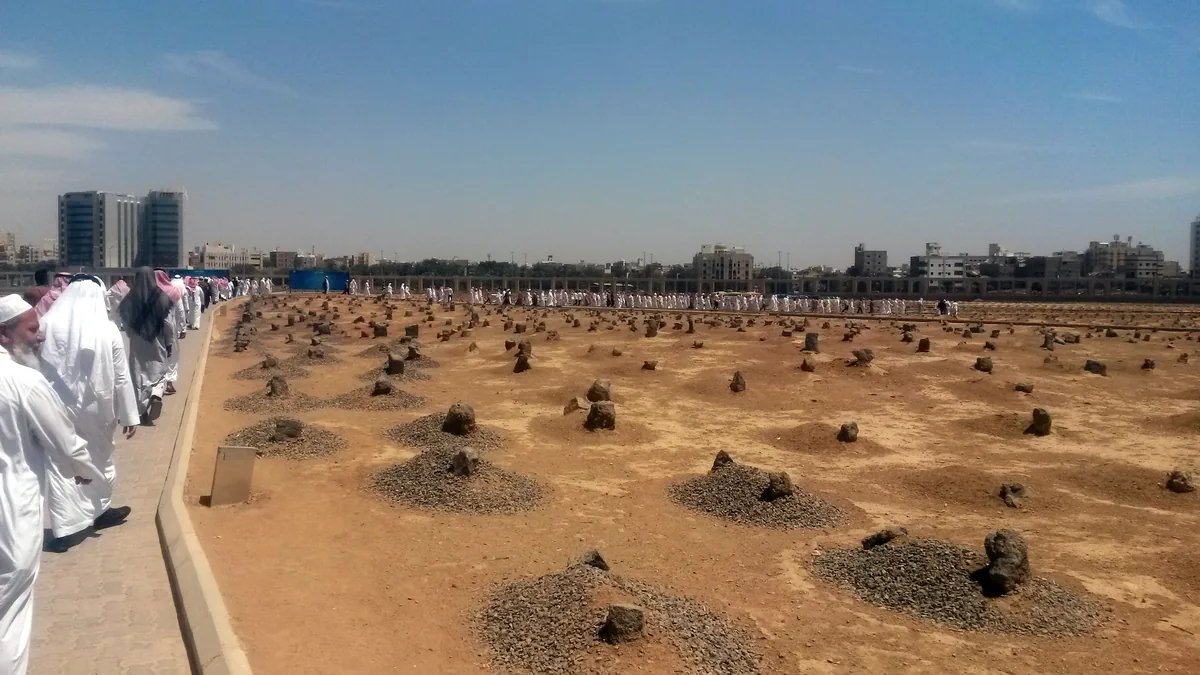
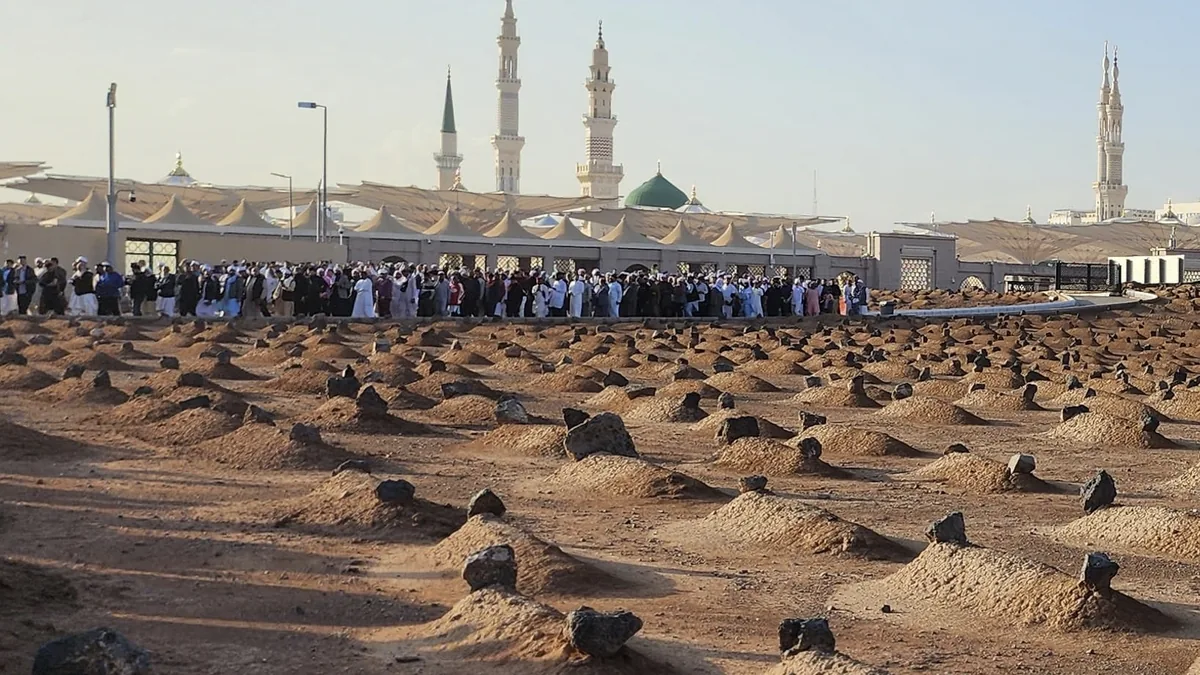
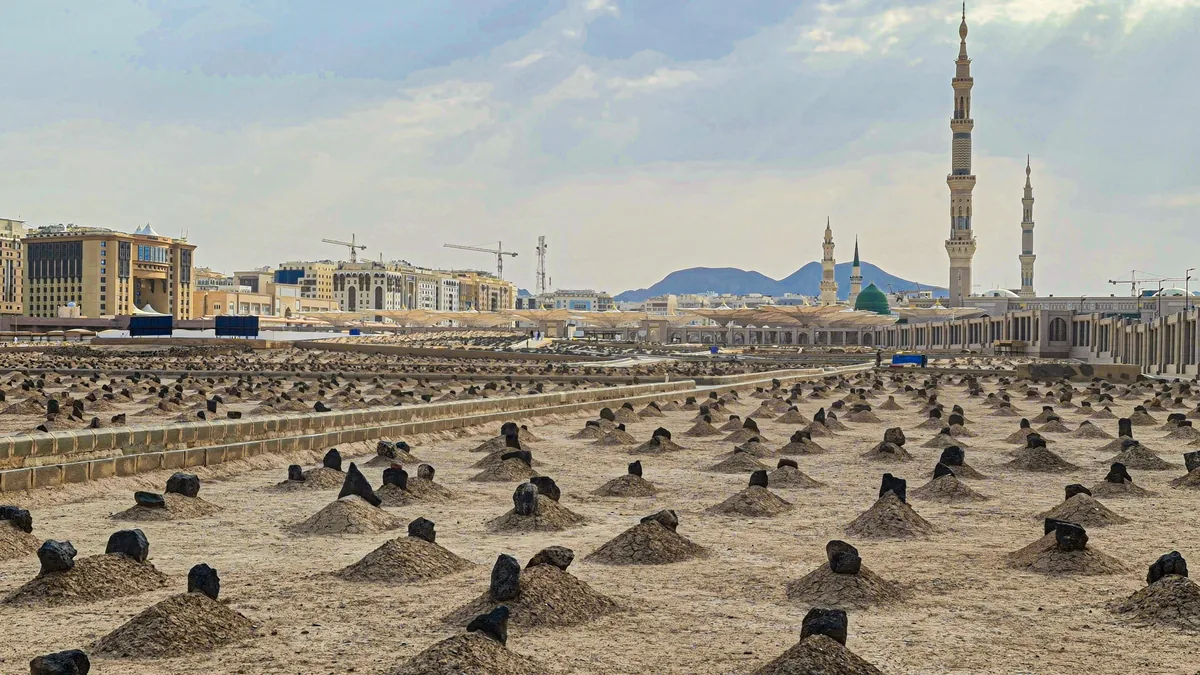
Today the cemetery is a large walled area of simple graves. It covers about 17 hectares, on our measurement of OpenStreetMap map data. People from Madinah are still buried here, so you may see a funeral during your visit.
You may also hear it called al-Baqi, the Baqi cemetery or the Baqi graveyard. All of these names mean the same place.
Where is Jannat ul Baqi?
The cemetery lies just south-east of Masjid an-Nabawi, across the mosque’s eastern courtyard. On OpenStreetMap data, its nearest edge is about 250 metres from the middle of the mosque. Most visitors walk there in five to ten minutes from the eastern gates.
A long wall runs around the cemetery, and visitors go in through a gate on the side facing the mosque. If you are unsure of the way, follow the crowd after Fajr or ask a steward in the courtyard.
Most hotels in the central area around the mosque are within walking distance. If you are staying further out, allow extra time to reach the eastern side of the mosque first, because the courtyard itself is very large.
A short history of the Baqi cemetery
The Prophet ﷺ chose al-Baqi as a burial ground soon after he settled in Madinah, and it has been used ever since. He buried his Companions and members of his family there, and he returned often to pray for them. Its later history includes a major change in the 20th century.
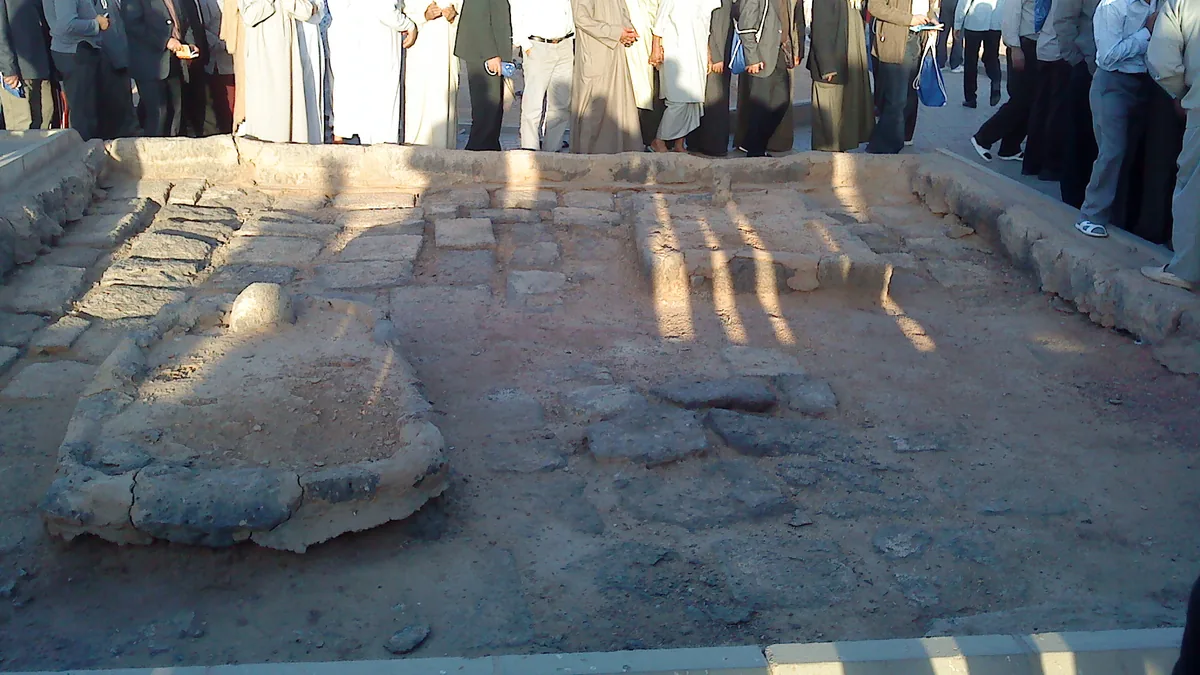
When the Companion Uthman ibn Maz’un died, the Prophet ﷺ carried a heavy stone to his grave himself and placed it at his head. He said:
“I am marking my brother’s grave with it, and I shall bury beside him those of my family who die.”
Reference: Sunan Abi Dawud 3206, graded hasan (al-Albani)
The Prophet ﷺ kept a close bond with the people of al-Baqi. Aisha reported that he would go out at the end of the night to greet them and pray for their forgiveness (Sahih Muslim 974a). In another report, he told her that the angel Jibril had brought a command from Allah to go and seek forgiveness for them (Sahih Muslim 974b).
Over the following centuries, domes and buildings were raised over some of the graves. In the mid-1920s, under the new Saudi state, these structures were demolished and the graves were left as simple mounds.
The authorities followed the view that graves should not be built over. It is based on the hadith in which the Prophet ﷺ forbade plastering graves, sitting on them or building over them (Sahih Muslim 970a). Many Muslims, including many Shia Muslims, regard the demolition as a great loss, and it is still remembered with sadness.
Whatever view you hold, the cemetery today is simple and open. The graves have no names or markers, so visitors come to greet the people buried there and to pray for them.
Who is buried in Jannat ul Baqi?
Many of the Prophet’s family, wives and Companions are buried here, along with generations of Madinah’s scholars and residents. Because the graves are unmarked today, most names come from historical reports. Where those reports differ, we say so in the table.
| Name | Who they were | Note |
|---|---|---|
| Uthman ibn Maz’un | An early Companion and Emigrant from Makkah | The Prophet ﷺ marked his grave with a stone (Sunan Abi Dawud 3206) |
| Wives of the Prophet ﷺ | The Mothers of the Believers, including Aisha | Aisha asked to be buried with the other wives at al-Baqi (Sahih al-Bukhari 1391) |
| Ibrahim | The Prophet’s infant son, who died as a baby | Widely reported in the histories |
| Uthman ibn Affan | The third caliph | Widely reported in the histories |
| Al-Abbas ibn Abd al-Muttalib | The Prophet’s uncle | Widely reported in the histories |
| Al-Hasan ibn Ali | The Prophet’s grandson | Widely reported in the histories |
| Fatimah | The Prophet’s daughter | Reports differ on where she is buried |
| Imam Malik ibn Anas | The scholar of Madinah whose teaching formed the Maliki school | Widely reported in the histories |
Aisha’s own wish shows how the wives of the Prophet ﷺ came to rest here. Before she died, she told Abdullah ibn al-Zubayr:
“Do not bury me with them (the Prophet (ﷺ) and his two companions) but bury me with my companions (wives of the Prophet (p.b.u.h) ) in Al-Baqi as I would not like to be looked upon as better than I really am (by being buried near the Prophet).”
Reference: Sahih al-Bukhari 1391
Historians also name several of the Prophet’s aunts and many Companions who fell ill or died in Madinah. Later generations of the Prophet’s family are buried here too, including Imams especially revered by Shia Muslims, such as Ja’far al-Sadiq.
On Fatimah, the reports genuinely differ. Many historians place her grave at al-Baqi, others place it in her house, which is now inside Masjid an-Nabawi, and Shia tradition holds that its location was kept hidden.
Why Muslims visit the graves
Visiting graves reminds us of death and the Hereafter, and it lets us pray for the people buried there. The Prophet ﷺ first forbade it, then allowed and encouraged it. At al-Baqi, you also follow his own practice of greeting the dead and asking Allah to forgive them.
Buraydah reported that the Prophet ﷺ said: “I forbade you to visit graves, but you may now visit them” (Sahih Muslim 977a). In another hadith, after visiting his mother’s grave, he explained why:
“I sought permission from my Lord to beg forgiveness for her but it was not granted to me, and I sought permission to visit her grave and it was granted to me so visit the graves, for that makes you mindful of death.”
Reference: Sahih Muslim 976b
So a visit to al-Baqi is not sightseeing. It is a chance to remember that life is short, to pray for the Companions who gave so much for Islam and to make dua for your own family who have passed away.
Jannat ul Baqi visiting times
In recent years, the gates have usually opened for men for a period after Fajr and after Asr. There is no official timetable online as of September 2026, and the times change with the seasons and the crowds. Ask at your hotel or check at the gate on the day.
| Visiting at a glance | Detail |
|---|---|
| Where | South-east of Masjid an-Nabawi, across the eastern courtyard |
| Usual opening | For men, for a period after Fajr and after Asr (check on the day) |
| Women | Usually not admitted inside; they can make dua from outside the wall |
| Best time | After Fajr, when it is cooler and calmer |
| How long to allow | 30 to 45 minutes, including the walk from the mosque |
| Photography | Widely discouraged inside; keep your phone away |
The gates can close earlier than expected, especially when a funeral is taking place. If you are set on visiting, go straight after the prayer rather than waiting in the mosque.
Can women visit Jannat ul Baqi?
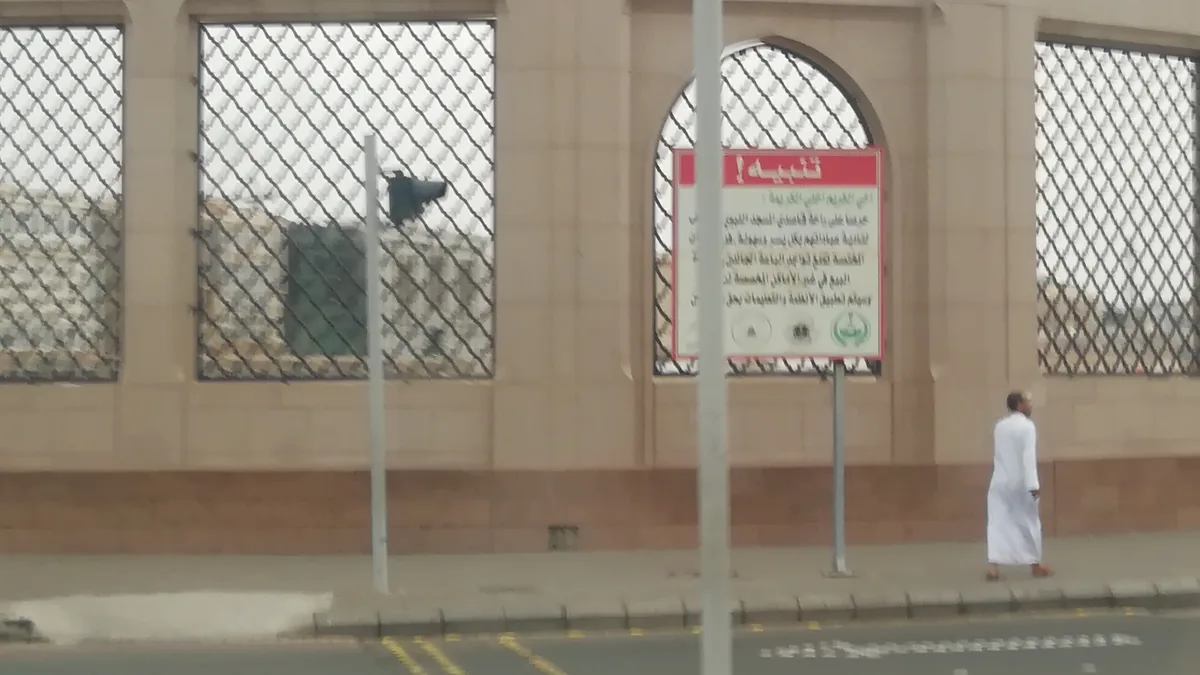
In current practice, women are usually not allowed inside the cemetery, but they can stand outside the wall and make dua. Scholars also differ on whether women should visit graves. Whatever the rule on the day, the greeting and your dua can still be said from outside.
The scholarly difference goes back to the hadith. One report says the Prophet ﷺ cursed women who visit the graves (Jami` at-Tirmidhi 1056, graded hasan by Darussalam). Imam at-Tirmidhi records two views on it: some scholars said it came before the permission to visit graves, which then included women, while others said visiting was disliked for women.
Another hadith shows the Prophet ﷺ teaching Aisha what to say for the people of al-Baqi when she asked him how to pray for them (Sahih Muslim 974b). Ask a qualified scholar which view to follow.
Our women’s Umrah guide has more practical advice for women visiting Madinah.
The dua for visiting Jannat ul Baqi
The Prophet ﷺ taught a greeting for the people of the graves, and he used it at al-Baqi himself. Aisha reported the words he said there, in Sahih Muslim 974a. You can say it quietly as you enter or stand by the wall, then make your own dua.
السَّلاَمُ عَلَيْكُمْ دَارَ قَوْمٍ مُؤْمِنِينَ وَأَتَاكُمْ مَا تُوعَدُونَ غَدًا مُؤَجَّلُونَ وَإِنَّا إِنْ شَاءَ اللَّهُ بِكُمْ لاَحِقُونَ اللَّهُمَّ اغْفِرْ لأَهْلِ بَقِيعِ الْغَرْقَدِ
As-salamu ‘alaykum dara qawmin mu’minin, wa atakum ma tu’aduna ghadan mu’ajjalun, wa inna in sha’Allahu bikum lahiqun. Allahumma-ghfir li-ahli Baqi’il-Gharqad.
“Peace be upon you, abode of a people who are believers. What you were promised would come to you tomorrow, you receiving it after some delay; and God willing we shall join you. O Allah, grant forgiveness to the inhabitants of Baqi’ al-Gharqad.”
Reference: Sahih Muslim 974a
The Prophet ﷺ also taught his Companions a shorter greeting for any graveyard. You can use it at al-Baqi, at the martyrs’ graves at Uhud or at a cemetery at home in the UK.
السَّلاَمُ عَلَيْكُمْ أَهْلَ الدِّيَارِ مِنَ الْمُؤْمِنِينَ وَالْمُسْلِمِينَ وَإِنَّا إِنْ شَاءَ اللَّهُ لَلَاحِقُونَ أَسْأَلُ اللَّهَ لَنَا وَلَكُمْ الْعَافِيَةَ.
As-salamu ‘alaykum ahlad-diyari minal-mu’minina wal-muslimin, wa inna in sha’Allahu la-lahiqun. As’alullaha lana wa lakumul-‘afiyah.
“Peace be upon you, the inhabitants of the city, among the believers, and Muslims, and God willing we shall join you. I beg of Allah peace for us and for you.”
Reference: Sahih Muslim 975
After the greeting, make dua in any language for the people buried here, for your own relatives who have died and for yourself. There is no set number of times to say it.
Etiquette: what to do and what to avoid
Greet the dead, pray to Allah for them and keep your voice low. Walk on the paths, not on the graves, and avoid anything that treats the graves as objects of worship. The Prophet ﷺ forbade sitting on graves and praying towards them (Sahih Muslim 972a).
- Do say the greeting. Use the words from Sahih Muslim 974a or 975, then make your own dua.
- Do pray to Allah alone. Ask Allah to forgive and have mercy on the people buried here.
- Do stay on the paths. Do not step or sit on graves, and keep children close.
- Do dress modestly. Wear clean, comfortable clothes and shoes you can walk in.
- Don’t pray salah facing the graves. Pray your salah in the mosque instead.
- Don’t touch or take anything. Leave the stones and soil as they are.
- Don’t film or take selfies. A cemetery is a place for quiet reflection, and families may be burying their relatives.
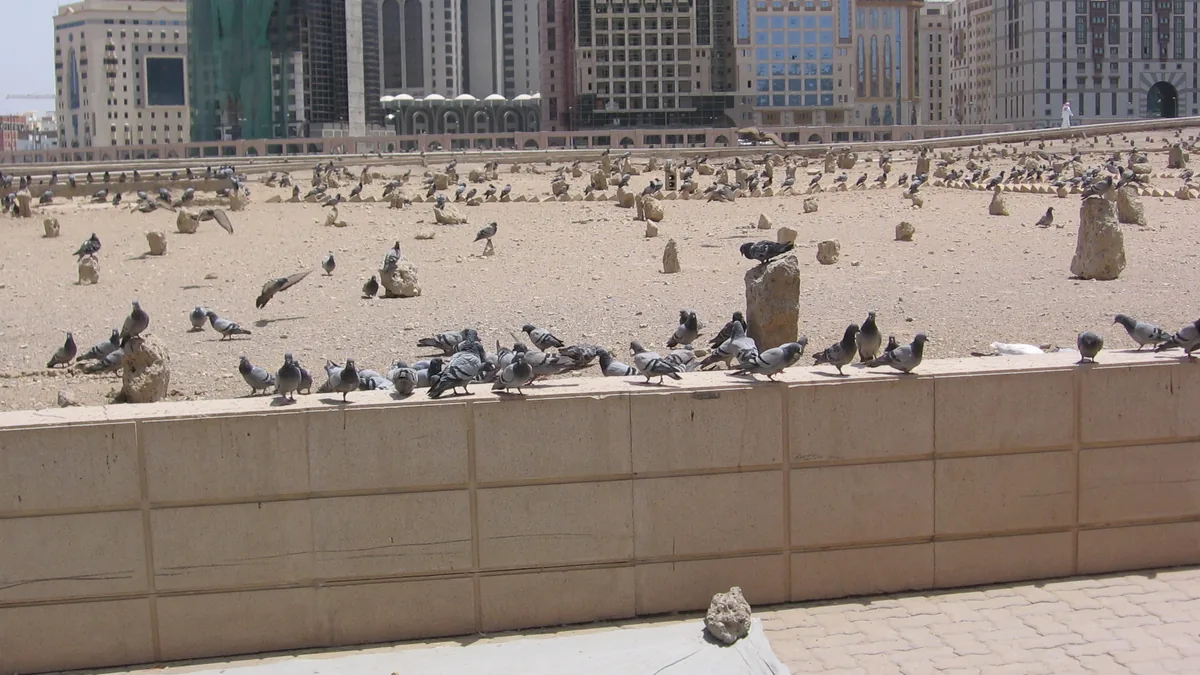
Staff at the cemetery may remind visitors of these rules. Follow their guidance politely, even if the practice where you come from is different.
Planning your visit from a Madinah hotel
Go after Fajr, when it is cooler and the gates are usually open, and take water and comfortable shoes. There is little shade inside, so avoid the middle of the day. If you are with a group, agree a meeting point by the mosque’s eastern gates before you go in.
- Timing. Pray Fajr in the eastern part of Masjid an-Nabawi, so you have a short walk afterwards.
- Heat. Even in winter, Madinah can be warm by late morning, so go early and carry water.
- Groups. Crowds leave the mosque at the same time, so pick a clear meeting spot.
- Access. Wheelchair users should ask staff at the gate about access, as parts of the site may be uneven.
At Travel to Umrah, we suggest visiting on your first or second morning in Madinah, before your days fill up. Staying close to the mosque makes early visits much easier, so compare options in our guide to hotels near Masjid an-Nabawi.
Other places to visit in Madinah
Combine al-Baqi with Masjid Quba, the martyrs’ graves at Uhud and Masjid al-Qiblatain. On OpenStreetMap data, Quba is about 3.3 km south of Masjid an-Nabawi, Masjid al-Qiblatain about 3.7 km to the north-west, and the Uhud martyrs’ cemetery about 3.9 km to the north.
- Masjid Quba. The first mosque of Islam. Read our guide to Masjid Quba for its history and the reward of praying there.
- Uhud. The site of the Battle of Uhud and the graves of its martyrs. See our guide to the Battle of Uhud and its lessons.
- Masjid al-Qiblatain. The mosque linked with the change of the qiblah towards Makkah.
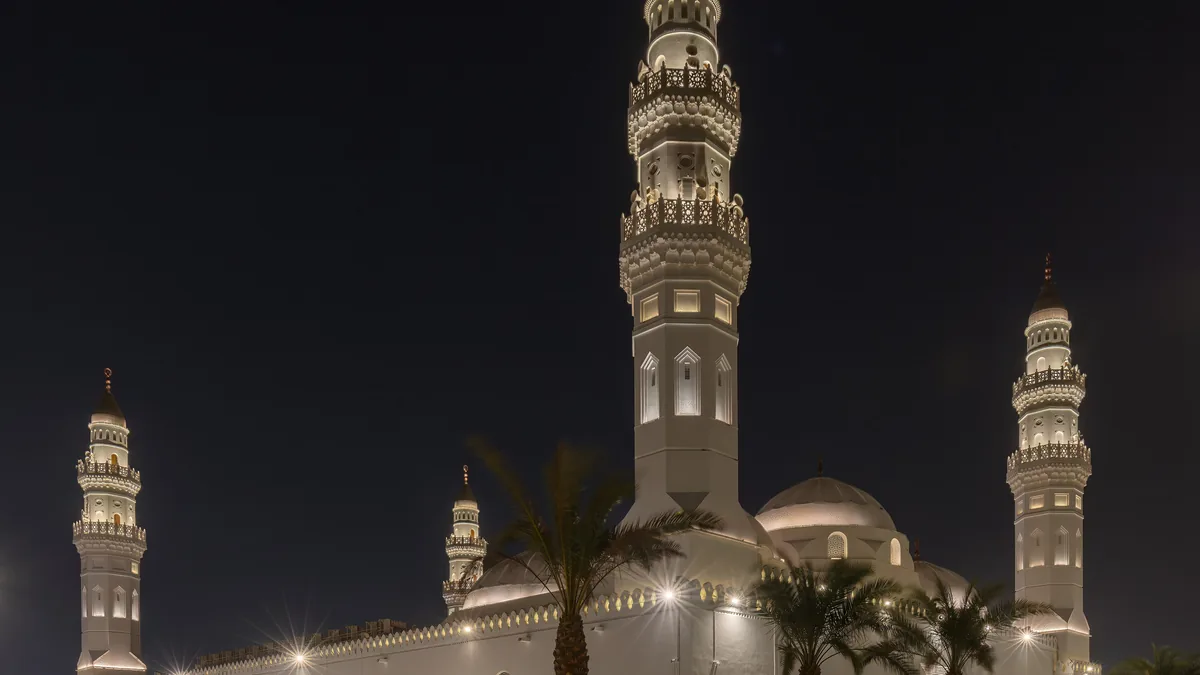
For a wider list, read our guide to ziyarat places in Makkah and Madinah.
Frequently asked questions about Jannat ul Baqi
What is the Baqi cemetery in Madinah?
It is the main cemetery of Madinah, just south-east of Masjid an-Nabawi. Its early name was Baqi al-Gharqad.
The Prophet Muhammad ﷺ buried members of his family and many Companions there. He often visited at night to pray for the people buried there (Sahih Muslim 974a).
Who is buried in al-Baqi?
Many of the Prophet’s family and Companions, including several of his wives, such as Aisha (Sahih al-Bukhari 1391).
Histories also name his son Ibrahim, his grandson al-Hasan, his uncle al-Abbas, the caliph Uthman ibn Affan and Imam Malik. The graves are unmarked, so exact places are not known.
Are women allowed inside Jannatul Baqi?
In current practice, women are usually not allowed inside the cemetery, but they can make dua from outside the wall.
Scholars differ on women visiting graves. The Prophet ﷺ taught Aisha a greeting for the people of al-Baqi when she asked how to pray for them (Sahih Muslim 974b).
What are the visiting times?
In recent years, the gates have usually opened for men for a period after Fajr and after Asr.
Times change, and there was no official timetable online as of September 2026, so check with your hotel or at the gate on the day. Going after Fajr is cooler and calmer.
Is Fatimah buried in al-Baqi?
Reports differ. Many historians say she is buried at al-Baqi, while others place her grave in her house, which is now inside Masjid an-Nabawi.
Shia tradition holds that the location of her grave was kept hidden. No grave at al-Baqi carries her name today.
Can I take photos in the Baqi graveyard?
It is best not to. Photography inside the cemetery is widely discouraged, and staff may ask you to put your phone away.
Many visitors find the visit more meaningful without a camera. Avoid filming other people, especially families at funerals and women outside the wall.
How far is it from Masjid an-Nabawi?
Very close. On OpenStreetMap data, the edge of the cemetery is about 250 metres from the middle of Masjid an-Nabawi, across the eastern courtyard.
Most people walk there in five to ten minutes from the mosque’s eastern gates.
Final thoughts: visiting Jannat ul Baqi
Jannat ul Baqi is where the Prophet ﷺ buried his family and Companions and where he came at night to pray for them. Go after Fajr, say the greeting from Sahih Muslim, make dua and leave quietly. Then continue to Masjid Quba, the first mosque of Islam.
When you are ready to plan your trip, compare our affordable Umrah packages, which start from £555 per person as of September 2026, with the visa included. We arrange flights from London, Manchester, Birmingham and other UK airports. Use the free quote form below, message us on WhatsApp or call +44 20 3287 2118, and the Travel to Umrah team will help you plan your days in Madinah.
Sources
We checked these sources in September 2026.
- Sahih Muslim 974a and 974b: the Prophet’s greeting and prayers at al-Baqi, Sunnah.com
- Sahih Muslim 975: the greeting for any graveyard, Sunnah.com
- Sahih Muslim 976b and 977a: permission to visit graves, Sunnah.com
- Sahih Muslim 970a and 972a: building over, sitting on and praying towards graves, Sunnah.com
- Sahih al-Bukhari 1391: Aisha’s wish to be buried at al-Baqi, Sunnah.com
- Sunan Abi Dawud 3206: the grave of Uthman ibn Maz’un, graded hasan (al-Albani), Sunnah.com
- Jami` at-Tirmidhi 1056: women visiting graves, with at-Tirmidhi’s notes on the scholarly views, Sunnah.com
- OpenStreetMap: al-Baqi cemetery and Masjid an-Nabawi, map data © OpenStreetMap contributors