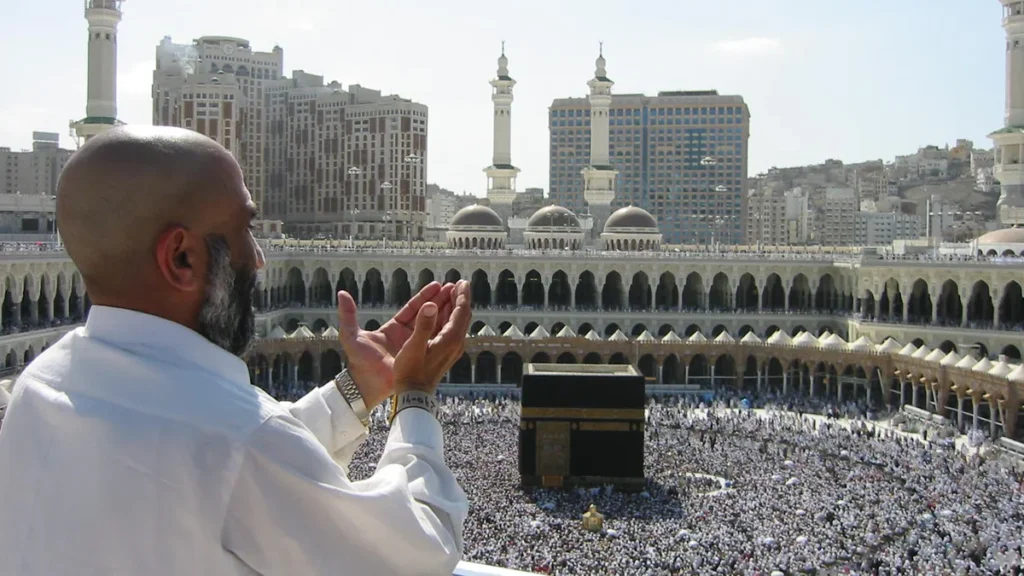
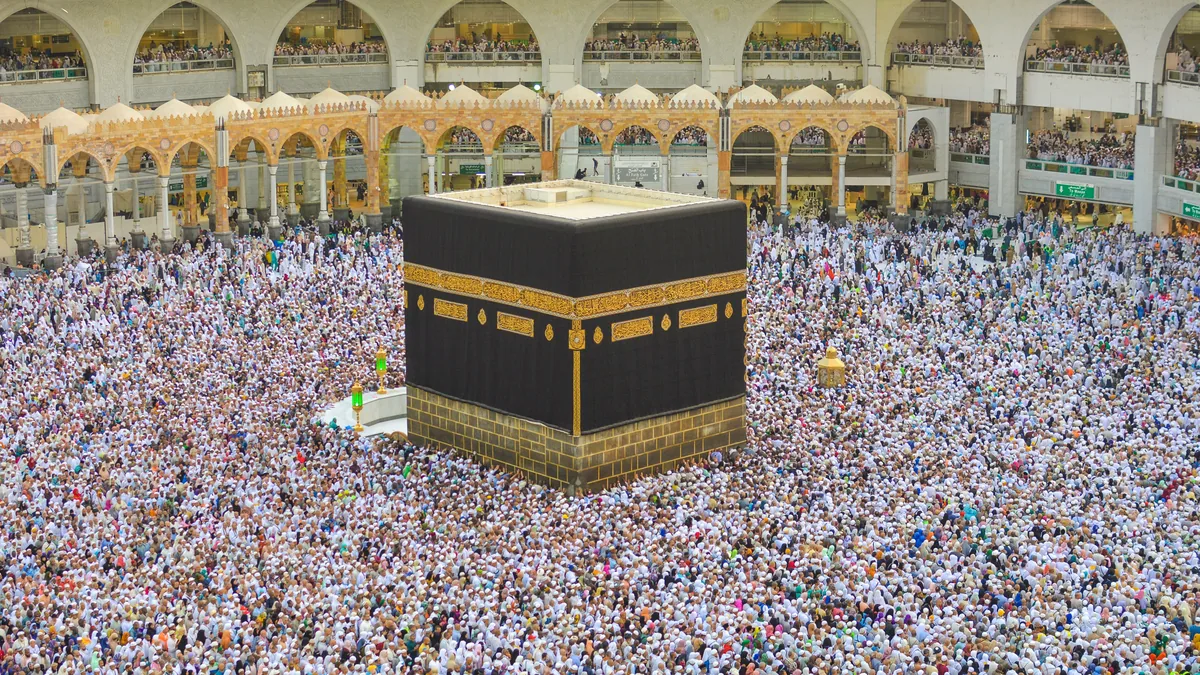
Tawaf means walking seven times around the Kaaba in Makkah as an act of worship. You walk anticlockwise, with the Kaaba on your left, and each circuit starts and ends in line with the Black Stone. It is the first rite you perform when you reach Masjid al-Haram for Umrah.
This guide explains what it is and why it matters. It then takes you through the seven circuits step by step, with what to recite and how long it takes on each floor. You will also find the rules for women and tips for older pilgrims, wheelchair users and families from the UK.
Quick answer
- Walk seven circuits around the Kaaba, anticlockwise, starting and ending at the Black Stone.
- Make wudu first. During Umrah, men uncover the right shoulder and walk briskly in the first three circuits.
- There is no fixed dua for each circuit. Between the Yemeni corner and the Black Stone, recite Quran 2:201.
- Allow 30 to 60 minutes near the Kaaba at a quiet time, and 1.5 to 2.5 hours on the upper floors.
What is Tawaf?
Tawaf is circling the Kaaba seven times as an act of worship. The word comes from an Arabic root that means to go around something. The official Nusuk guide describes it as circling the Kaaba while worshipping the Lord of the House and drawing closer to Him.
You walk around the Kaaba anticlockwise, so it is always on your left. Each circuit begins and ends in line with the corner that holds the Black Stone. Seven circuits make one complete Tawaf.
The Kaaba stands in the middle of Masjid al-Haram, the Sacred Mosque in Makkah. The open marble courtyard around it is called the Mataf, which means “the place of Tawaf”. The mosque also has upper floors and a roof, where you can walk your circuits when the courtyard is full.
Circling the Kaaba is part of every Umrah and every Hajj. You can also do it on its own as a voluntary act of worship, at almost any time of the day or night. Many pilgrims make extra circuits of the Kaaba throughout their stay in Makkah.
Muslims face the Kaaba in every prayer, wherever they are in the world. Walking around it in person is one of the most moving moments of the whole journey. To learn more about the mosque itself, read our guide to the history of Masjid al-Haram.
Why Tawaf matters: the Quran and the Sunnah
Allah tells pilgrims to circle the ancient House in the Quran, and the Prophet Muhammad ﷺ showed how to do it. It is a pillar of Umrah, so there is no Umrah without it. The Prophet ﷺ also compared it to prayer, which is why the manners of prayer apply.
ثُمَّ لْيَقْضُوا۟ تَفَثَهُمْ وَلْيُوفُوا۟ نُذُورَهُمْ وَلْيَطَّوَّفُوا۟ بِٱلْبَيْتِ ٱلْعَتِيقِ
Thummal-yaqdu tafathahum wal-yufu nudhurahum wal-yattawwafu bil-baytil-‘atiq.
“Then let them end their untidiness and fulfill their vows and perform ṭawāf around the ancient House.”
Reference: Quran 22:29, Saheeh International translation
The verse speaks about the pilgrims of Hajj. “The ancient House” is the Kaaba, the house of worship that every Muslim faces in prayer.
Ibn Abbas reported that the Prophet ﷺ said:
“Tawaf around the House is similar to Salat except that you talk during it. So whoever talks in it, then let him not say but good.”
Reference: Jami` at-Tirmidhi 960, graded hasan (Darussalam)
Imam at-Tirmidhi notes that some narrators report these words from Ibn Abbas himself. Either way, the lesson is clear. You may talk as you walk, but keep it to good words, dhikr and dua.
The Prophet ﷺ taught the rite mainly by doing it. His Companions watched closely and reported the details, from where he started to how he walked. The steps in this guide come from those reports, with references so you can check them yourself.
The types of Tawaf
There are five main types. The one you perform for Umrah is a pillar of Umrah. Three others, called al-Qudum, al-Ifadah and al-Wada’, belong to Hajj, and any extra circuits you make are voluntary (nafl).
| Type | When | Status | Raml and idtiba (men) |
|---|---|---|---|
| Tawaf of Umrah | On arrival for Umrah, before Sa’i | Pillar of Umrah | Yes |
| Tawaf al-Qudum (arrival) | On arrival, for Hajj al-Ifrad and Hajj al-Qiran | Sunnah in most schools | Yes |
| Tawaf al-Ifadah | On or after 10 Dhul Hijjah, during Hajj | Pillar of Hajj | Usually no |
| Farewell Tawaf (al-Wada’) | Just before leaving Makkah after Hajj | Wajib in most schools | No |
| Nafl (voluntary) | Any time during your stay | Voluntary | No |
The Tawaf of Umrah
You perform this as soon as you reach the Haram in ihram for Umrah. It comes before Sa’i, and all four Sunni schools count it as a pillar. If you are going for Umrah only, this is the one this guide mainly covers.
Tawaf al-Qudum: on arrival
Pilgrims doing Hajj al-Ifrad or Hajj al-Qiran perform it when they first arrive in Makkah. Most scholars count it as Sunnah. For pilgrims doing Hajj al-Tamattu’, the circuits of their Umrah take its place.
Tawaf al-Ifadah
This is a pillar of Hajj, so Hajj is not complete without it. Pilgrims perform it on or after the 10th of Dhul Hijjah, after Arafah and Muzdalifah. It is also known as Tawaf al-Ziyarah.
The farewell Tawaf
Known in Arabic as al-Wada’, this is the last thing pilgrims do before they leave Makkah after Hajj. Ibn Abbas described the rule in these words:
“The people were ordered to perform the Tawaf of the Ka`ba (Tawaf-al-Wada`) as the lastly thing, before leaving (Mecca), except the menstruating women who were excused.”
Reference: Sahih al-Bukhari 1755
Most schools count it as wajib for Hajj pilgrims. For Umrah, scholars differ, and many say it is recommended rather than required. If you have time, it is a beautiful way to say goodbye to the Kaaba.
Voluntary circuits
You can make extra circuits as often as you like during your stay, and you do not need to be in ihram. Men do not uncover the shoulder or walk briskly in them. Pray two rak’ahs afterwards, just as you do in Umrah.
Before you start Tawaf
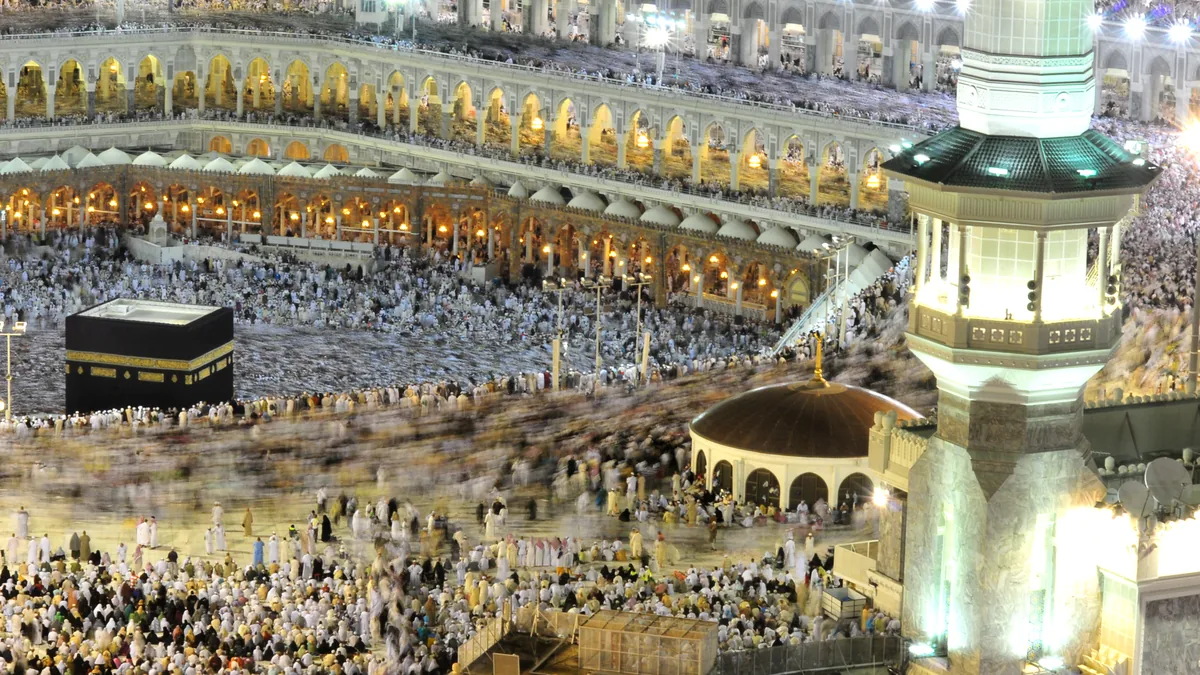
Make wudu, check that your ihram is on correctly and put your shoes in a small bag. Then make the intention in your heart. If you are doing Umrah, you should already be in ihram from the miqat.
Wudu
Aisha reported that the first thing the Prophet ﷺ did on reaching Makkah was make wudu, and then he circled the Kaaba (Sahih al-Bukhari 1614). The Maliki, Shafi’i and Hanbali schools say circuits made without wudu do not count.
The Hanafi school treats wudu as a duty rather than a condition, so it deals with mistakes differently. Either way, the advice is the same: make wudu before you start. Toilets and wudu areas are near the gates, so use them before you go in.
Intention
The intention, or niyyah, is in the heart. You do not need to say special words out loud. Simply know what you are about to perform, such as the circuits of your Umrah.
Ihram and clothing
Men wear two white ihram sheets and open sandals, following the Prophet’s guidance on ihram clothing (Sahih al-Bukhari 1542). Women wear ordinary modest clothes. For a reminder of the rules, read our guide to the meaning and rules of ihram.
If you fly from the UK to Jeddah and go straight on to Makkah, you must enter ihram before the plane crosses the miqat. Our guide to the miqat for UK pilgrims explains when and how to do it.
Shoes
Most pilgrims take off their shoes and carry them in a small drawstring bag. That way, you do not have to return to the same door to find them. The mosque has dozens of gates, and it is easy to come out of a different one.
Where Tawaf starts: the Black Stone
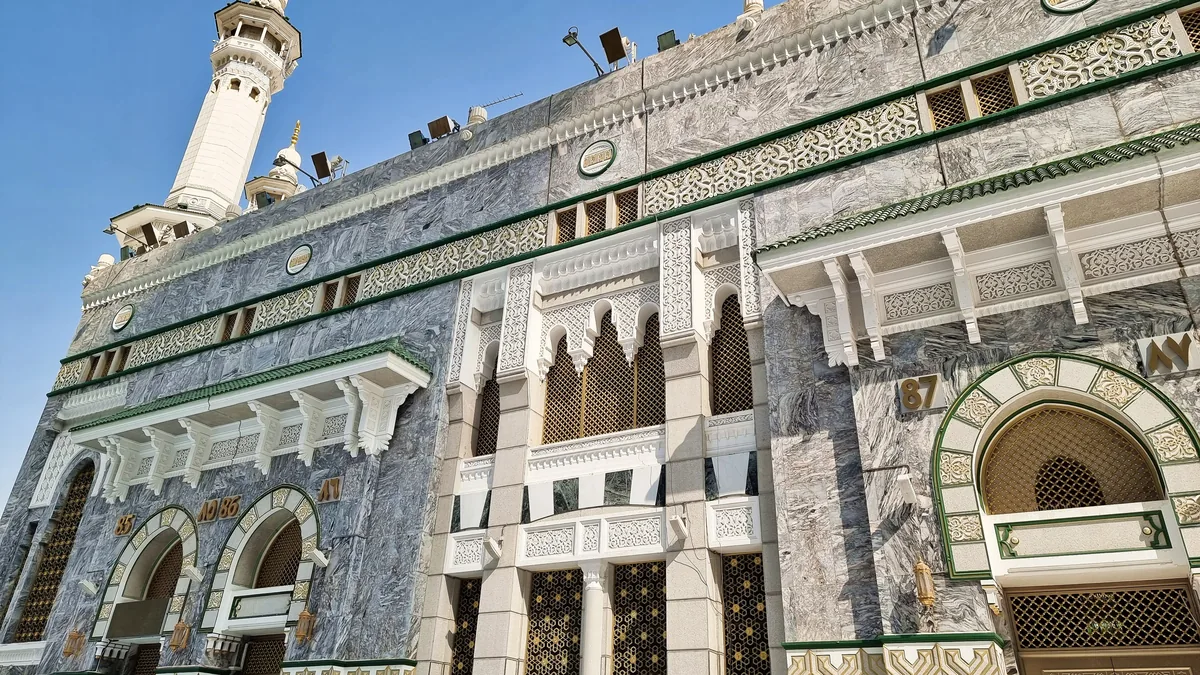
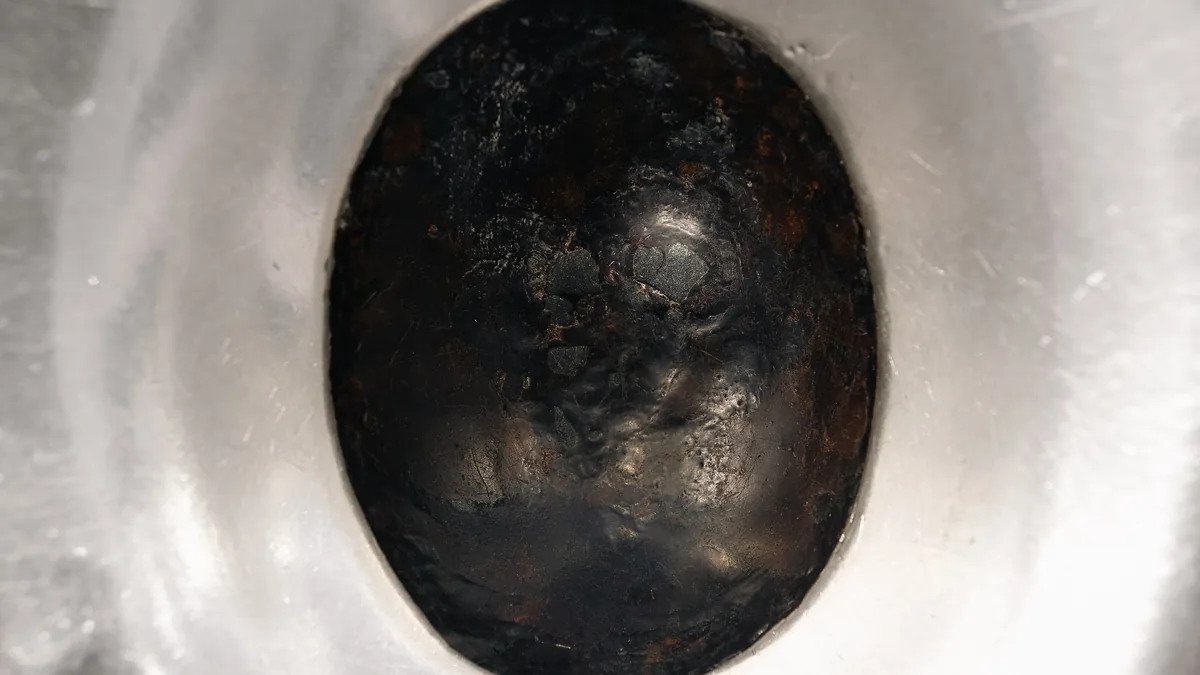
You start in line with the corner of the Kaaba that holds the Black Stone. A green light on the mosque wall facing that corner marks the start and end line. Face the Black Stone, raise your right hand towards it, say “Allahu Akbar” and begin.
Finding the Black Stone corner
The Black Stone is set in a silver frame in the eastern corner of the Kaaba. As you start walking with the Kaaba on your left, you pass the door of the Kaaba first. Then you pass the low curved wall of Hijr Ismail.
If you cannot see the green light, just line yourself up with the Black Stone corner itself. On the upper floors, look down to find the same corner, and ask a steward if you are not sure.
Istilam: greeting the Black Stone
Istilam means touching or kissing the Black Stone, or pointing to it when you cannot reach it. Ibn Umar saw the Prophet ﷺ kiss the Black Stone corner as he began his circuits (Sahih al-Bukhari 1603). When he rode a camel around the Kaaba, he pointed towards it instead.
“The Prophet (ﷺ) performed Tawaf of the Ka`ba riding a camel, and every time he came in front of the Corner (having the Black Stone), he pointed towards it with something he had with him and said Takbir.”
Reference: Sahih al-Bukhari 1613
Umar ibn al-Khattab kissed the Black Stone and then spoke to it. His words remind us why we honour it:
“No doubt, I know that you are a stone and can neither benefit anyone nor harm anyone. Had I not seen Allah’s Messenger (ﷺ) kissing you I would not have kissed you.”
Reference: Sahih al-Bukhari 1597
So when the crowd is heavy, pointing from a distance is the Sunnah for you. It is also far safer than pushing towards the corner.
How to perform Tawaf step by step
Stand in line with the Black Stone, raise your hand and say “Allahu Akbar”, then walk anticlockwise with the Kaaba on your left. Each time you reach the Black Stone line again, you have finished one circuit. After seven circuits, you are done.
- Get ready. Enter the Mataf in wudu. For Umrah, men wear the upper ihram sheet under the right arm, so the right shoulder is bare.
- Find the line. Go to the Black Stone line, marked by the green light. The Nusuk guide says to stand next to the Black Stone, with it on your left.
- Begin. Face the Black Stone, raise your right hand and say “Allahu Akbar”. Kiss or touch it only if you can do so without pushing.
- Walk. Walk anticlockwise with the Kaaba on your left. For Umrah, men walk briskly in the first three circuits, then at a normal pace.
- Pass the Yemeni corner. Touch the Yemeni corner with your right hand if you can reach it easily. Between that corner and the Black Stone, recite Quran 2:201.
- Complete the circuit. When you reach the Black Stone line, one circuit is done. Raise your hand, say “Allahu Akbar” and carry on.
- Finish at seven. After the seventh circuit, you have finished. Men cover the right shoulder again, then everyone prays two rak’ahs.
Raml and idtiba: the Sunnah for men
Raml means walking briskly with short steps, close to a gentle jog. Jabir ibn Abdullah reported that the Prophet ﷺ did this in the first three circuits and walked in the other four (Sahih Muslim 1218). Ibn Umar reported the same (Sahih al-Bukhari 1603).
Idtiba means wearing the upper ihram sheet under the right armpit, with both ends over the left shoulder, so the right shoulder is bare. The official Nusuk guide lists both as Sunnah for men. They belong to the circuits of Umrah and of arrival for Hajj, not to voluntary ones.
When the Mataf is packed, you may not be able to walk briskly at all. Never push to do it. Take small, quick steps if there is room, and walk normally if there is not.
The Yemeni corner
The Yemeni corner, or Rukn al-Yamani, is the corner you reach just before the Black Stone. Ibn Umar said he only saw the Prophet ﷺ touch the two Yemeni corners of the Kaaba (Sahih al-Bukhari 1609). These are the Black Stone corner and this one.
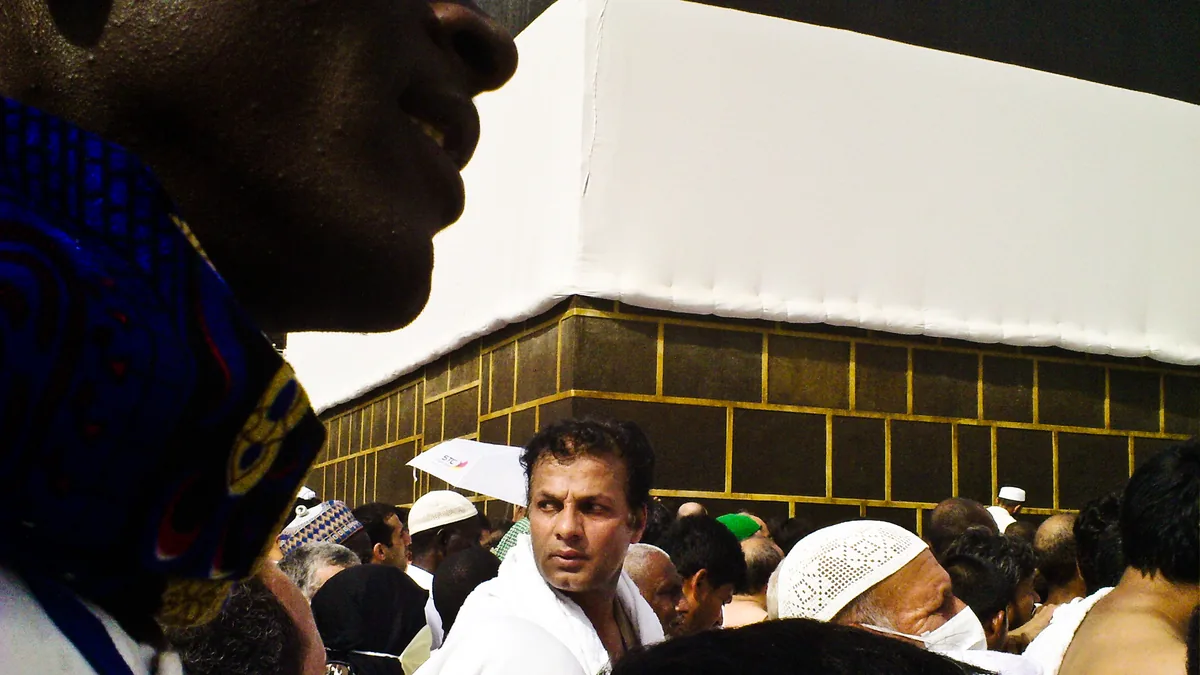
Touch it with your right hand if you can reach it easily, but do not kiss it. Most scholars say you should not point to it from a distance either. If you cannot touch it, simply walk on.
Stay outside Hijr Ismail
Hijr Ismail, also called the Hateem, is the low curved wall on one side of the Kaaba. Aisha asked the Prophet ﷺ about it:
“I asked the Prophet (ﷺ) whether the round wall (near Ka`ba) was part of the Ka`ba. The Prophet (ﷺ) replied in the affirmative. I further said, “What is wrong with them, why have they not included it in the building of the Ka`ba?” He said, “Don’t you see that your people (Quraish) ran short of money”
Reference: Sahih al-Bukhari 1584
So you must walk around the outside of the curved wall. Most scholars say that a circuit that cuts through the gap between the Hijr and the Kaaba does not count. If this happens, repeat that circuit.
Counting your circuits
Each circuit starts and ends at the Black Stone line, so every time you cross it, you add one. The table shows how the seven circuits work. A tally counter or a note on your phone helps, especially in a crowd.
| Circuit | Starts at | Men walk briskly? |
|---|---|---|
| 1 | Black Stone line | Yes (raml) |
| 2 | Black Stone line | Yes (raml) |
| 3 | Black Stone line | Yes (raml) |
| 4 | Black Stone line | No, normal pace |
| 5 | Black Stone line | No, normal pace |
| 6 | Black Stone line | No, normal pace |
| 7 | Black Stone line, and ends there | No, normal pace |
If you lose count, most scholars advise going with the number you are sure of, which is the lower one. So if you cannot decide between four and five, count four and carry on.
If the prayer starts partway through
When the call to start the prayer is made, stop and join the prayer where you are. Afterwards, carry on from where you stopped. Some scholars prefer that you restart that circuit from the Black Stone line, so ask your group’s scholar which view they follow.
If you lose your wudu
If you lose your wudu partway through, leave the Mataf and renew it. Scholars differ on whether you then continue from where you stopped or start again. Ask a qualified scholar, and keep the gap as short as you can.
What to say during Tawaf
There is no fixed dua for each circuit. At the Black Stone, say “Allahu Akbar”, and between the Yemeni corner and the Black Stone, recite Quran 2:201. The rest of the time, make dua in any language, remember Allah or recite the Quran.
Between the Yemeni corner and the Black Stone
Abdullah ibn as-Sa’ib heard the Prophet ﷺ say this dua between the two corners. The report is in Sunan Abi Dawud 1892, graded hasan by al-Albani, and the words are a verse of the Quran.
رَبَّنَآ ءَاتِنَا فِى ٱلدُّنْيَا حَسَنَةً وَفِى ٱلْـَٔاخِرَةِ حَسَنَةً وَقِنَا عَذَابَ ٱلنَّارِ
Rabbana atina fid-dunya hasanatan wa fil-akhirati hasanatan wa qina ‘adhaban-nar.
“Our Lord, give us in this world [that which is] good and in the Hereafter [that which is] good and protect us from the punishment of the Fire.”
Reference: Quran 2:201, Saheeh International translation
This short stretch comes at the end of every circuit, so you will say it seven times. Learn it before you travel, so you do not need to read it from your phone.
At the Black Stone
Each time you reach the Black Stone line, face it, raise your right hand and say “Allahu Akbar”. This follows the practice of the Prophet ﷺ and the official Nusuk guide. Then turn and carry on walking.
The rest of each circuit
For most of each circuit, you are free to make your own dua. Pray for yourself, your family and anyone who asked you to remember them. English is fine, because Allah hears every language.
You can also recite the Quran or repeat simple dhikr, such as “SubhanAllah”, “Alhamdulillah” and “La ilaha illallah”. Keep your voice low, so you do not disturb the people around you.
What about the duas in booklets?
Many booklets print a long dua for each of the seven circuits. You may read them as general duas, but the Prophet ﷺ did not teach a fixed dua for each circuit, so you do not need to learn them. Reading while you walk in a crowd can also make you lose count.
A good idea is to write a short list of duas on your phone before you go. The seven circuits give you time to go through it slowly and sincerely.
After Tawaf: Maqam Ibrahim, Zamzam and the Multazam
After your seventh circuit, pray two rak’ahs behind Maqam Ibrahim if there is room. If it is crowded, pray them anywhere in the mosque. Then drink some Zamzam water before you go on to Sa’i.
Two rak’ahs at Maqam Ibrahim
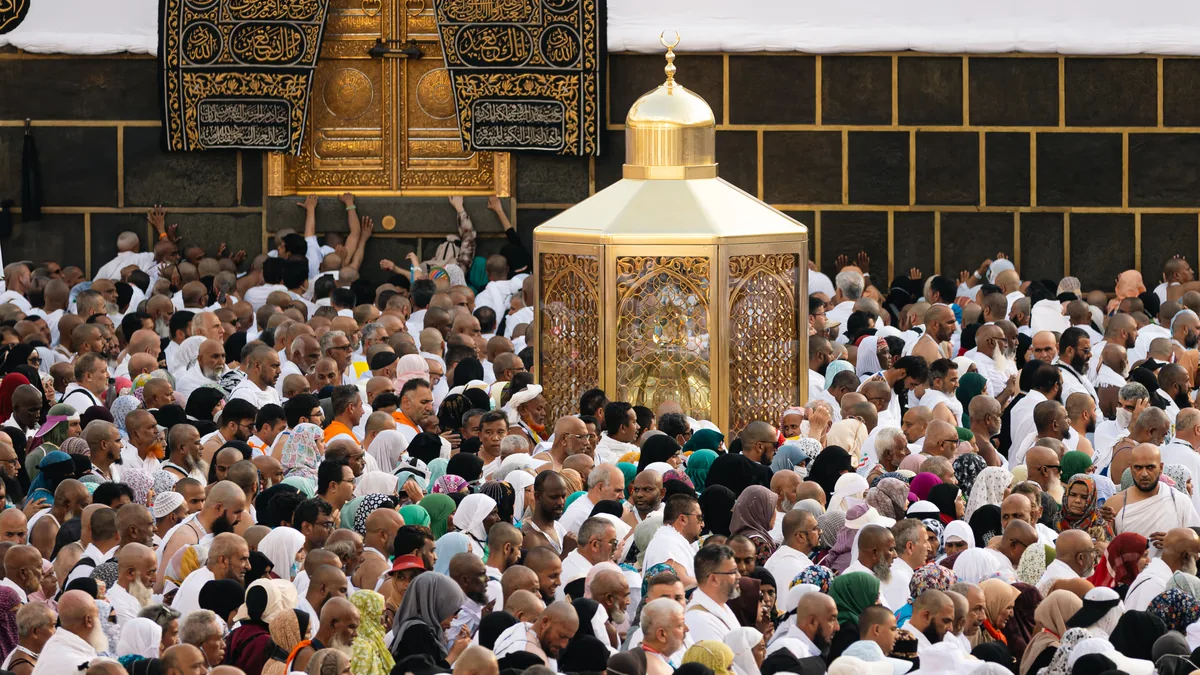
Maqam Ibrahim, the Station of Ibrahim, is a stone kept in a small gold and glass case near the Kaaba. Allah mentions it in the Quran.
وَٱتَّخِذُوا۟ مِن مَّقَامِ إِبْرَٰهِـۧمَ مُصَلًّى
Wattakhidhu min maqami Ibrahima musalla.
“And take, [O believers], from the standing place of Abraham a place of prayer.”
Reference: Quran 2:125, Saheeh International translation
Jabir reported that the Prophet ﷺ recited this verse as he went to the Station after his circuits. He prayed two rak’ahs with the Station between him and the Kaaba. The report adds that he recited Surah al-Ikhlas and Surah al-Kafirun in them (Sahih Muslim 1218).
When the area behind the Maqam is packed, do not force your way in. Most scholars say you can pray these two rak’ahs anywhere in the mosque. Men should cover both shoulders again before they pray.
Zamzam
Next, drink some Zamzam water. The Prophet ﷺ drank Zamzam during his Hajj (Sahih Muslim 1218), and free coolers stand all around the mosque. Our guide to the benefits of Zamzam water explains its history.
Jabir’s report also says the Prophet ﷺ went back and kissed the Black Stone before walking to Safa. This is a Sunnah, so if the crowd is heavy, you can leave it out and go straight to Safa.
The Multazam
The Multazam is the part of the Kaaba wall between the Black Stone and the door. Some of the Companions pressed themselves against it and made dua there. Scholars differ on how strong these reports are.
Today it is one of the most crowded spots in the Mataf. If you cannot reach it safely, make your dua from where you are. Allah hears you just as well.
How long does Tawaf take?
Tawaf usually takes 30 to 60 minutes on the ground floor near the Kaaba at a quiet time. It can take 1.5 to 2.5 hours on the upper floors or at busy times, because each circuit is longer and the crowd slows you down.
How far you walk depends on how close you are to the Kaaba. We measured the Kaaba and the Mataf on OpenStreetMap map data in September 2026. A circuit close to the Kaaba, including the curve around Hijr Ismail, is only about 70 to 80 metres.
The outer edge of the open courtyard is about 540 metres around. The upper floors surround that courtyard, so every circuit up there is longer than 540 metres. Seven of them add up to about 4 km or more.
| Where you walk | One circuit | Seven circuits | Typical time |
|---|---|---|---|
| Ground floor, close to the Kaaba | 70 to 80 m | About 0.5 km | 30 to 60 minutes |
| Ground floor, outer edge | About 540 m | About 3.8 km | About 1 to 1.5 hours |
| Upper floors and roof | More than 540 m | About 4 km or more | 1.5 to 2.5 hours |
Close to the Kaaba, the distance is short but the crowd is thickest, so you move slowly. Further out, you walk further but more freely. The times in the table include short pauses at the Black Stone line.
Quieter times are usually mid-morning and late at night, outside Ramadan. The busiest times are just after each of the five daily prayers, when thousands start their circuits together.
Tawaf on the upper floors, in a wheelchair or on a cart
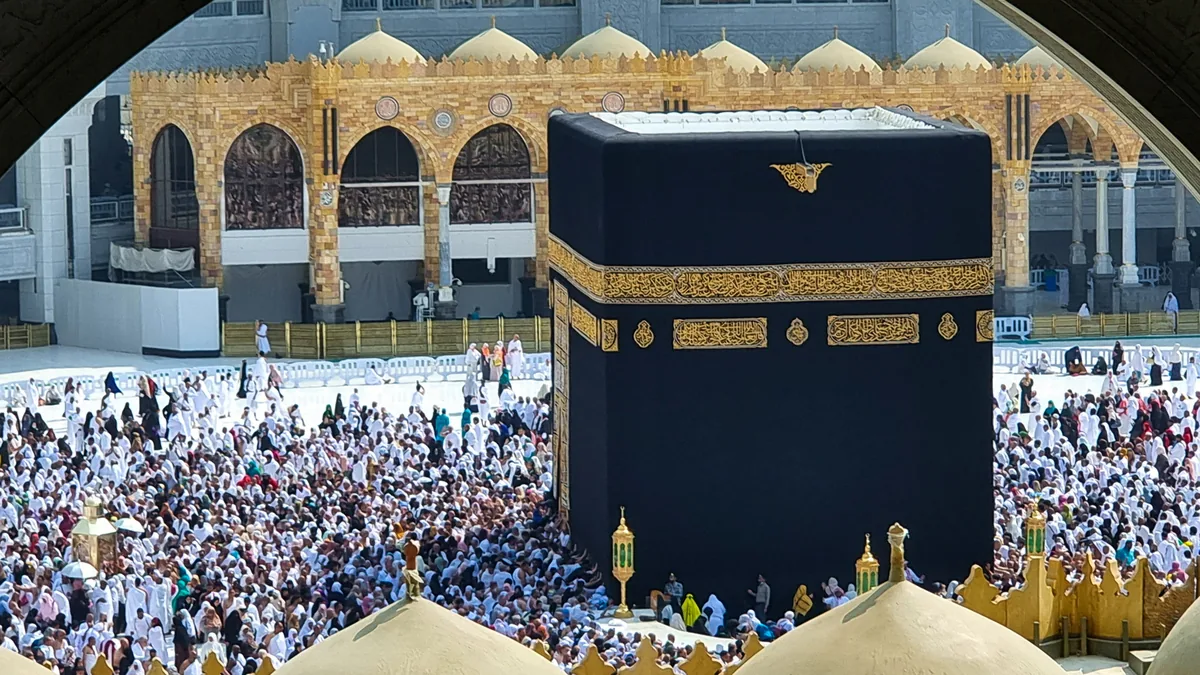
You can walk your circuits on the upper floors or the roof of Masjid al-Haram, and they are just as valid as on the ground floor. Wheelchair users are often directed upstairs, where the flow is steadier. The circuits are longer, so allow more time.
Being pushed or carried is fine. As the hadith above shows, the Prophet ﷺ himself went around the Kaaba riding a camel (Sahih al-Bukhari 1613).
Wheelchairs are a common sight in the Haram. Ask your hotel or group leader where to borrow or hire one on the day, as the options and prices change. Some pilgrims use electric carts or mobility scooters, but the rules and booking points for these change from season to season.
On the upper floors, keep the Kaaba on your left, just as you would below. Start and end each circuit in line with the Black Stone corner, and ask a steward if you are not sure where that is.
For more help with planning, read our Umrah travel tips for people with disabilities. If someone in your group has limited mobility, mention it when you ask for a quote, so we can suggest a hotel close to the Haram.
Tawaf rules for women
Women perform it in the same way as men, but without raml or idtiba. They walk at a normal pace throughout and keep their usual modest dress. A woman who has her period waits until she is clean before she begins.
Dress
In ihram, women wear ordinary modest clothes that cover the body. The Prophet ﷺ said that “the Muhrima (a woman in the state of Ihram) should not cover her face, or wear gloves” (Sahih al-Bukhari 1838). Scholars discuss how this applies when men are close by, so ask a qualified scholar if you usually wear a face veil.
Periods
When Aisha’s period started during Hajj, the Prophet ﷺ told her what to do:
“So do what all the pilgrims do except that you do not perform the Tawaf round the Ka`ba till you are clean.”
Reference: Sahih al-Bukhari 305
So if your period starts before you have circled the Kaaba for Umrah, wait until it ends, then complete the circuits and Sa’i. You stay in ihram while you wait, so build some flexibility into your dates if you can. Ask a qualified scholar about your own situation.
Some women ask their GP about medicine to delay a period while they travel. That is a medical decision, so speak to your GP well before you fly. Our women’s Umrah guide has more practical advice.
Finding space
If the crowd near the Kaaba is heavy, walk further out, where there is more room. If you are walking with male relatives, agree a meeting point before you start, in case you get separated.
Common mistakes during Tawaf
The most common mistakes are walking through Hijr Ismail, pushing to reach the Black Stone and losing count. Others include starting away from the Black Stone line and stopping suddenly in the crowd. Each one is easy to avoid once you know about it.
- Walking through Hijr Ismail. The Hijr is part of the Kaaba, so always walk around the outside of its curved wall.
- Pushing to kiss the Black Stone. Kissing it is a Sunnah, but harming other people is not allowed. Pointing from a distance is enough.
- Starting in the wrong place. Start and end every circuit in line with the Black Stone, or the circuit is not complete.
- Walking the wrong way. Keep the Kaaba on your left the whole time.
- Losing count. Use a counter, and go with the lower number if you are unsure.
- Brisk walking in every circuit. Raml is only for men, and only in the first three circuits.
- A bare shoulder in prayer. Men uncover the right shoulder only while circling the Kaaba. Cover both shoulders for the two rak’ahs and for every prayer.
- Stopping in the flow. A sudden stop for a photo or a dua can cause a crush. Move to the edge first.
If you realise afterwards that you made a mistake, do not panic. Ask a qualified scholar or your group leader what to do, because the answer depends on the mistake and your school of thought.
Tips for a calmer Tawaf
Choose a quieter hour, agree a meeting point with your group and move to the edge if you need to rest. Carry water and keep your shoes in a small bag. These simple steps make the circuits calmer, especially with older parents or young children.
- Timing. Outside Ramadan, mid-morning and late at night are usually calmer than the time just after the main prayers.
- Heat. The ground floor is open to the sky, so avoid midday in the summer months. Night-time circuits are cooler.
- Meeting point. Agree a numbered gate or a fixed spot before you start, in case you get separated.
- Children. Hold young children’s hands at all times, and put a card with your phone number in their pocket.
- Water. Drink some Zamzam before you start, and again before Sa’i.
- Your phone. Put it on silent and keep it in a zipped pocket or bag.
- Rest. If you feel tired, move gently to the outer edge before you slow down or stop.
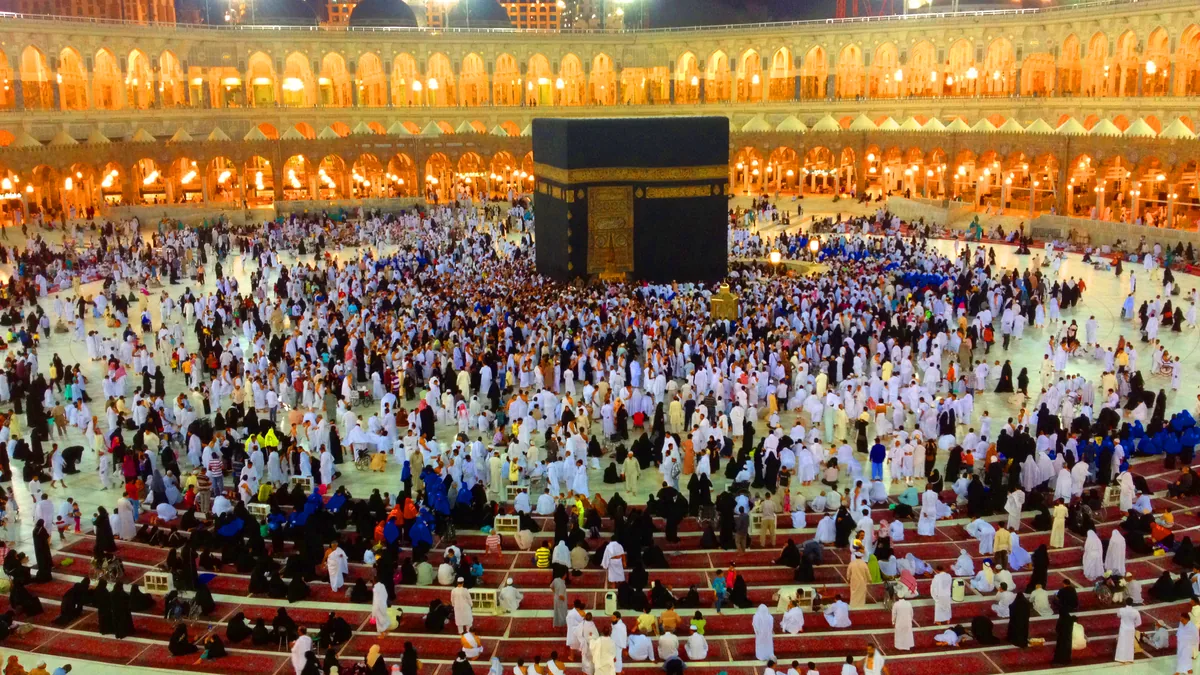
A hotel close to the mosque makes it easier to go back for extra circuits at quiet times. Compare the options in our guide to hotels near the Haram in Makkah. At Travel to Umrah, we can suggest hotels that suit your budget and your walking needs.
Frequently asked questions about Tawaf
How many rounds are there in Tawaf?
There are seven rounds, also called circuits. Each one starts and ends in line with the Black Stone, and you walk anticlockwise with the Kaaba on your left.
During Umrah, men walk briskly in the first three rounds. If you are unsure whether you have done six or seven, most scholars say count six and walk one more.
Do you need wudu for Tawaf?
Yes. The Maliki, Shafi’i and Hanbali schools say circuits made without wudu do not count, and the Hanafi school treats wudu as a duty. The Prophet ﷺ made wudu before he first circled the Kaaba (Sahih al-Bukhari 1614).
If you lose your wudu partway through, renew it and ask a scholar whether to continue or start again.
Can I wear shoes or slippers during Tawaf?
Most pilgrims take off their shoes and carry them in a small bag, as in any mosque. Clean footwear does not spoil your circuits, and the Prophet ﷺ even prayed in his sandals (Sahih al-Bukhari 386).
If you need footwear for a medical reason, such as foot problems linked to diabetes, wear clean, soft slippers and ask your GP for advice before you travel.
What if I lose count during Tawaf?
Go with the number you are sure of, which is the lower one, as most scholars advise. So if you cannot decide between four and five rounds, count four and carry on.
A small tally counter, a note on your phone, or moving a ring from finger to finger after each round will help you avoid the problem.
Can women do Tawaf during their period?
No. The Prophet ﷺ told Aisha to do everything the other pilgrims did except Tawaf until she was clean (Sahih al-Bukhari 305). A woman in ihram for Umrah waits until her period ends, then completes the circuits and Sa’i.
Women on their period are excused from the farewell Tawaf after Hajj. Ask a qualified scholar about your own situation.
Can I do Tawaf on the upper floors?
Yes. Circuits on the upper floors or the roof are valid, and they are often calmer when the courtyard is full. Each circuit is longer than 540 metres by our measurement, so seven can take 1.5 to 2.5 hours.
Keep the Kaaba on your left, and start and end each circuit in line with the Black Stone corner.
How long does a full Tawaf take?
It usually takes 30 to 60 minutes on the ground floor near the Kaaba at a quiet time. On the upper floors, or at busy times, it can take 1.5 to 2.5 hours.
These are our estimates, because the crowd sets the pace. Allow extra time if you are older, pushing a wheelchair or walking with young children.
Can I do extra Tawaf after Umrah?
Yes. You can make voluntary circuits as often as you like during your stay, and you do not need ihram. Men do not uncover the shoulder or walk briskly in them.
Pray two rak’ahs afterwards, just as you do in Umrah. Many pilgrims make it a daily habit between the prayers.
Final thoughts: your next step after Tawaf
Tawaf is seven circuits of the Kaaba, walked anticlockwise from the Black Stone, with dua and dhikr along the way. Make wudu, keep count and pray two rak’ahs when you finish. Then walk to Safa for the next rite.
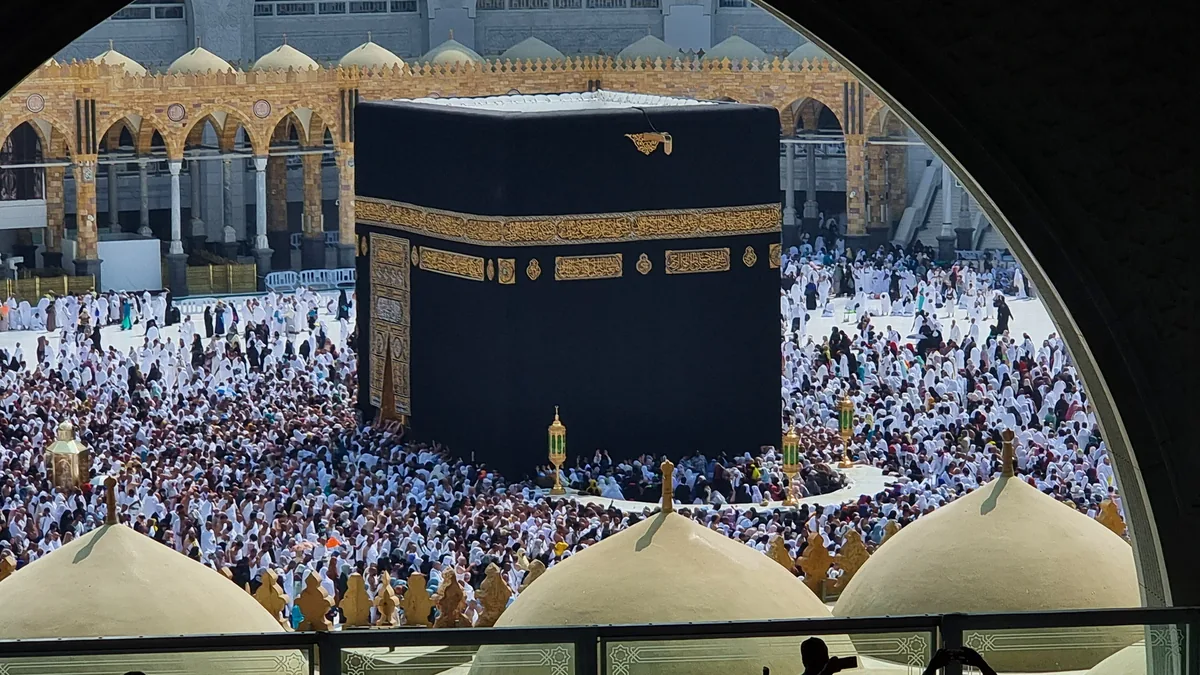
When you are ready to plan your trip, compare our affordable Umrah packages, which start from £555 per person as of September 2026. We arrange flights from London, Manchester, Birmingham and other UK airports. Use the free quote form below, message us on WhatsApp or call +44 20 3287 2118, and the Travel to Umrah team will help you choose your dates.
Sources
We checked these sources in September 2026.
- Quran 22:29, Quran 2:125 and Quran 2:201, Saheeh International translation, Quran.com
- Jami` at-Tirmidhi 960: Tawaf is like prayer, graded hasan (Darussalam), Sunnah.com
- Sunan Abi Dawud 1892: the dua between the two corners, graded hasan (al-Albani), Sunnah.com
- Sahih al-Bukhari 1597, 1603, 1609 and 1613: the Black Stone, raml and the Yemeni corner, Sunnah.com
- Sahih al-Bukhari 1584: Hijr Ismail is part of the Kaaba, Sunnah.com
- Sahih al-Bukhari 1614: wudu before Tawaf, Sunnah.com
- Sahih al-Bukhari 1755: the farewell Tawaf, Sunnah.com
- Sahih al-Bukhari 305 and 1838: rules for women, Sunnah.com
- Sahih al-Bukhari 1542 and 386: ihram clothing and praying in sandals, Sunnah.com
- Sahih Muslim 1218a: Jabir’s account of the Prophet’s Hajj, Sunnah.com
- Nusuk: the Umrah journey, the official Saudi guide to the rites
- OpenStreetMap: the Mataf and the Kaaba, map data © OpenStreetMap contributors